Showing posts with label chicks. Show all posts

Tuesday, August 9, 2016

Chicken predators, the loss of my Americana chickens

The loss of my Americana chickens.

    The loss of a chicken flock is never easy to take. You always feel as if you didn't do enough to protect your flock. Living in the deserts of Nevada you are always thinking about predators. Every fence, every cage and every chicken hutch is built with predators in mind. And it really doesn't matter what type of livestock or garden crop you're raising, the wildlife here in the desert considers anything and everything that you are growing as part of the menu. It is only a matter of time before a predator takes notice and then the battle of wits begins. 
    Coyotes are far more intelligent than dogs but both species consider a fence a minor obstacle. But unlike dogs, coyotes will actually sit, watch and then analyze in order to find a solution to a problem or in this case my fence and a chicken coop. Once they find a solution they not only act upon it themselves but convey the solution to other members of the pack and work as a team in a coordinated effort to get at their prey.  
    I actually watched a coyote pack run a jackrabbit to ground. The coyote pack sat on a hill as each member took turns chasing the jackrabbit. Normally the jackrabbit can out run a single coyote, but the coyote knows that a jackrabbit is territorial and won't run outside of its own territory . This means the jackrabbit will continually run in a circle until it can't run anymore. 
    Now in my case the fence was not a real problem as I had not completed it yet. The problem was I locked up my chickens at night and only allowed them to free range during the day. Solution; attack the chicken flock during the day when the owner was away. Which means the coyotes had been watching for several days before they made an actual move on the flock. 
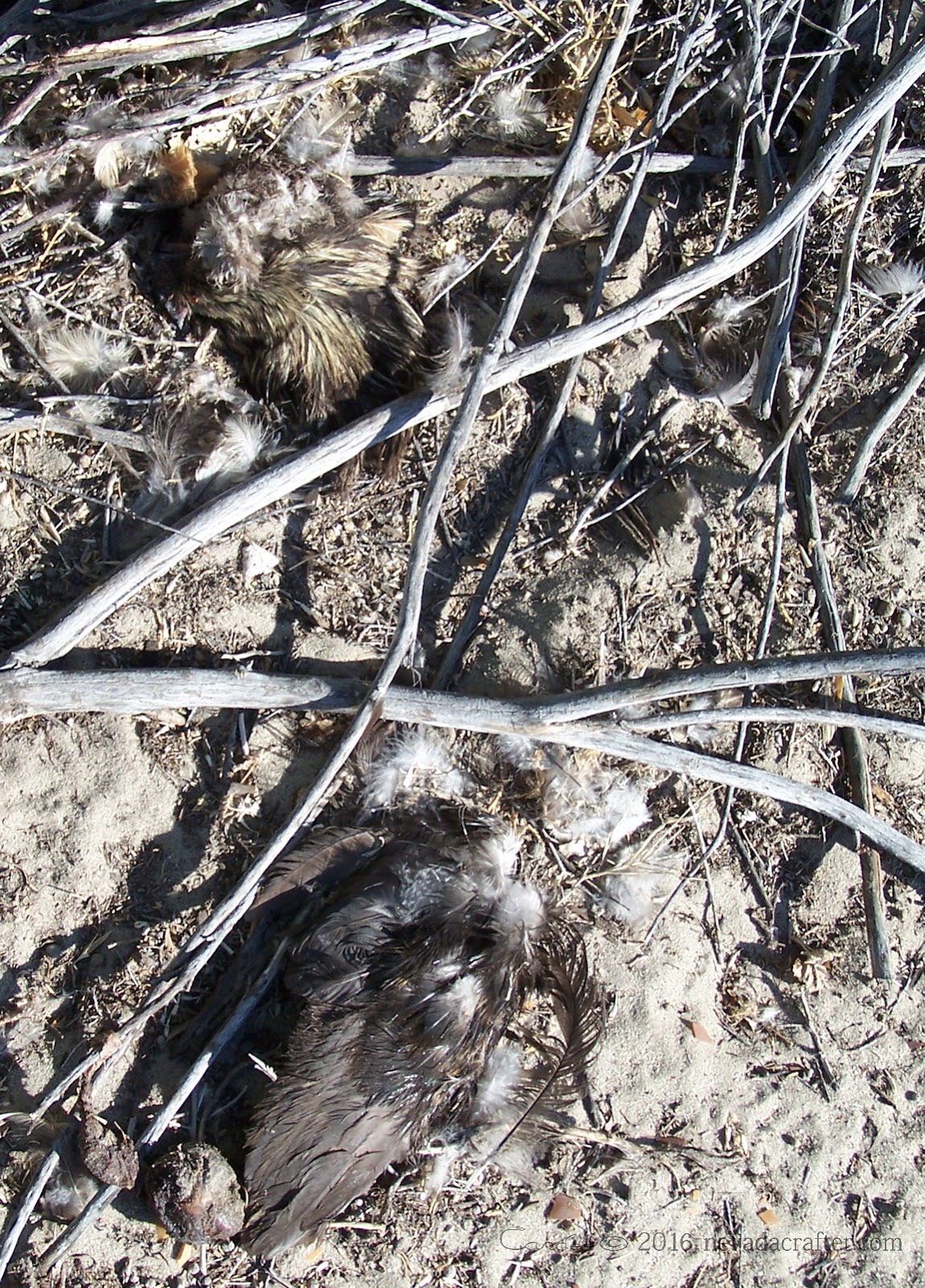
Remains of Americana chickens after coyote attack.
    The photo above is what remains of my Americana chickens. You have to give coyotes credit, they seldom leave any waste behind. The only thing that I was able to find was a head and a couple of wings. This may be a gruesome sight to some, but growing up in the deserts of Nevada and being around wildlife and livestock all the time gives you a different perspective on life. This sort of event takes place daily as animals in the desert struggle to survive. For that matter everything in this universe feeds on everything else, and every living thing must consume some other living thing in order to survive. 
    Now the mistakes I made were several. The first mistake I made was in letting my guard down because I had not had a coyote attack in several years. I assumed that the chickens would be safe as long as I locked them up at night. 
    The second mistake I made was not completing the fence before letting the chickens to free range . Usually I run one or two strands of Barb wire at the bottom of the fence and below ground. This is usually enough to deter most predators but as I have found with coyotes they are problem solvers and the minute you solve one problem they will find another chink in your armor when you're not looking. 
    The third mistake that I made was not paying attention to the other wildlife in the area . I had noted several ravens hanging around before the attack took place . Ravens are a scavenger bird and probably even more clever than the coyotes. But the one thing I've learned about ravens is they like to follow predators so they can pick up on the left overs . I had not seen any hawks and mistakenly assumed the ravens were just simply passing through. 
    The fourth mistake was not remembering my own history . The last time they attacked they wiped out a flock of 20 barred rock chickens in a single night and I never did find even a single body part. 
    As to the hole under the fence and I am not sure if it was a way out or a away in, but unfortunately I've had to set steel traps in hopes of catching the predators responsible.  This also poses the dilemma of trying to keep my own dog out of the traps and having to lock up my other flocks of chickens even in the heat of the day. 
    I now have an unexpected project of trying to improve my defenses and anticipate another attack. The coyotes have learned that there is an easy meal here and most likely will not leave until all my chickens are gone. 
    And so life goes on as I continue my own struggle to survive under trying times and difficult conditions. The desert is relentless and if it is not coyotes it is something else. The challenge is to learn from my mistakes and at the same time realize that nothing is forever. That when I am no longer here, the desert will undo everything I have done and reclaim what I have taken from it. 

Wednesday, August 5, 2015

What do you feed poultry?


Well first, let's talk about what to store your feed in. I personally use trash cans with locking lids. They provide an inexpensive way to store poultry feed out of the weather and away from rodents. Your main concern is to keep the feed dry so it does not spoil or get moldy, either of which would not be good to feed your poultry. Your second concern is keeping rodents out of your feed, as not only would they consume the feed that you intended for your poultry, but would also pose a health threat to your poultry and to you. In addition to the health threat rodents would also attract predators such as cats, snakes, hawks and owls.
     It is a good idea to use a measuring cup so as you can adjust the amount of feed that you're giving them. You should treat your poultry as you would goldfish, never feeding more than they can eat within a 15 minute period. This eliminates waste and reduces the chances of wild animals getting into the feed that was intended for your livestock. 


Lay pellets or pellet feed is the most common poultry feed. This is usually a blend of grains and alfalfa or just straight alfalfa that is mashed and pressed into pellets. It is an adult feed that is high in protein and helps with the production of eggs. Although this may not be your poultry's favorite food it is one of their mainstays. 
I have found that if I feed this to them in the morning I have less problems with them eating it. Otherwise they act like a bunch of kids eating their ice cream before eating their broccoli. 


An alternative to lay pellets is a feed referred to as crumbles. This generally has a similar composition of ingredients but instead of being in the form of large pellets it is in the form of small crumbles. This is a feed that can be given to adult poultry as well as smaller poultry. It is not recommended by the Department of Agriculture for chicks as it does not contain antibiotics or growth hormones. Personally though I think we have enough antibiotics and growth hormones in our food supply as it is. Chick start also comes in this form which is not recommended to be fed to your adult poultry or any poultry that is laying eggs. You can get chick start without antibiotics or growth hormones, but I have found it to be expensive compared to just buying regular crumbles. Chick start is generally intended for baby chicks that are being raised in a brooder, where sanitation can be a problem. As I raise my chickens free range it would be impossible to use this type of feed without my laying hens getting into it as well.
    Chicken scratch is usually a mix of grains and cracked corn. I usually feed this to my chickens later in the day so it does not spoil their appetite for the lay pellets or crumbles. I will also sprinkle a small handful in areas around my gardens to encourage the chickens to thatch specific areas. As this product usually has a large quantity of corn in it, I can also use this to fatten up poultry that I intend to butcher. If I need an even larger fat content I can also purchase straight cracked corn. You can also purchase straight whole grains such as wheat and barley to create your own blends or to manage food costs.
You can also purchase products such as whole-wheat (livestock feed or food grade )for the purposes of sprouting the wheat in order to create a product referred to as fodder. Fodder is essentially sprouted grains which adds bulk and increases the nutrient content to the feed that you're giving them in addition to giving them greens. This can also reduce feed costs substantially as it increases the bulk of the food by at least 2 to 3 times its original volume. The grain is generally sprouted in flat tray containers for seven days and then fed to the livestock. With the rising cost of alfalfa hay, fodder has also become popular with larger livestock such as cattle and horses as well.
    One of the ways that I grow my own fodder is to simply use clear plastic storage containers with holes drilled at one edge for drainage. Place 1 cup of whole wheat or other grain in the storage container and then water and drain once daily. I do not sprout the wheat for much more than seven days as beyond that it tends to mold. When it is ready to harvest I also clip the wheatgrass for my own consumption and use it in salads or make wheatgrass juice using a special juicer for wheatgrass juicing. I can then feed the remaining product to my livestock, which is cool because nothing goes to waste. One of your other feed products that you need to keep in mind is called oyster shell. This is essentially oyster shell that has been crushed into small enough pieces that your poultry can then consume. It is generally fed your poultry to add calcium to their diet and is generally fed to them when you need to thicken the shells of the eggs that your poultry are laying.
Oyster shell can be purchased at your local feed supplier but whenever possible you should try to purchase your oyster shell in 40 or 50 pound bags. The reason for this is that many retailers will try to sell you a 1 to 5 pound bag for the same cost as the 50 pound bag. Oyster shell does not spoil and generally a 50 pound bag will last you several years for a small flock of 20 or 30 birds. I do not feed oyster shell to my poultry on a regular basis as feeding them too much will cause egg shells to become extremely thick and making eggs difficult to crack when cooking. I can also use egg shells as a substitute or supplement so long as I crush the egg shells before feeding them back to my poultry. The reason for this is that I do not want my poultry to recognize the egg shells as a food source. If they think that eggs are a food source they will begin to cannibalize their own eggs and once they start cannibalizing their own eggs it is near impossible to break them of the habit.
    Table scraps are also another source of food that can be used to supplement your poultry's diet, but you should use extreme care in how you handle and what you feed your poultry from your table. Like many pets and livestock, chocolate, onionsand apple seeds are food product that you should never feed them. Greens or vegetable trimmings, as well as breads, and other grains are safe to feed your livestock so long as it is not spoiled or moldy. Meat products should be avoided as it will cause chickens to lay eggs with blood spots and may taint the flavor of the eggs. Although my father told me that when the family was raising poultry commercially during the depression, they would quite often catch live carp and other bottom fish to feed to the poultry. As the poultry they were raising were for meat, blood spots in the eggs was not a problem and it was a cheap source of protein for the chickens. It is said that chickens are closely related to prehistoric raptors and after witnessing chickens eating another live animal, you never look at a chicken the same way ever again.
    Free-range chickens will quite often eat mice and other small animals if they can catch them, but it should not be of serious concern as it doesn't happen very often. I do recommend that you fence your chickens out of your food garden as many of the foods that we like such as tomatoes are also a favorite of theirs. I have had turkeys in my food garden as they have a preference for eating insects and weeds but as with any poultry you may have to keep an eye on them and discourage them from eating anything that you consider food . Poisonous or toxic weeds are generally not a concern as most are bad tasting and your poultry won't eat a sufficient quantity to be lethal. Some flowers and other ornamental plants may have to be protected with a short fence or cage, but for the most part they will do you a huge favor by thatching your yard and removing insect pests such as Grubbs and scorpions.
    If you have any additional questions be sure and contact your local extension office which is usually associated with the state agricultural University. And for more garden and livestock information check out the following link.http://nifa.usda.gov/Extension/


Thank you for stopping by, please check out our other videos on YouTube and our other blogs and be sure and subscribe.

Tuesday, June 30, 2015

How to handle unexpected baby chicks

Unexpected baby chicks can sometimes present unexpected problems. And depending on how you are raising your chickens depends on how you handle the problem.

  1. Option one is to remove the baby chicks from the mother and raise the baby chicks in a brooder.
  2. Option two is to allow the mother hen to raise the baby chicks.

[Free range chickens]

Chickens that are being raised free range and allowed to roam can be the easiest to handle. But there are a few things that you need to keep in mind. Allowing the mother hen to raise the baby chicks may mean less work for you but the chicks will be exposed to possible predators and other hazards. This also means that if a hen hatches out 10 baby chicks by the time they're half grown you may only have two or three that will have survived. A lot depends on how experienced a mother hen is with raising chicks and her skills in handling large numbers of wandering baby chicks. A new mother hen may only successfully hatch out two or three her first time, but as she gains experiences she will hatch out more and rear larger numbers. It should also be noted that it depends on the breed of chicken as to whether they are good mothers are not. Bantam's have an awesome reputation for being the best mothers. As a matter of fact we use to use bantams to hatch out and raise our other breeds of poultry.
    Regular watering and feed dishes that you use for adult poultry can actually pose a hazard to young chicks. For this reason large open watering dishes should not be used as they pose a drowning hazard, and feed dishes also can become a trap. Use watering and feed dishes designed for baby chicks or feeders and waters that they can't get stuck in.
   Feeding the mother hen and her chicks may also pose a problem as the feed that you're giving her and her baby chicks may not be good for the rest of the flock, especially if the chick food contains antibiotics. Laying hens should never be fed any kind of antibiotic while they are laying eggs. Personally I do not feel that antibiotics is a necessary ingredient in chick food unless you're raising hundreds of baby chicks at a time. As a matter of fact I avoid using any kind of feeds that have antibiotics or GMO's added to them.
    One solution to feed is to feed the entire flock a crumbles mix that doesn't have any antibiotics. Most feed stores will carry this type of poultry feed . It has the same nutritional value as many of the other feeds that your using but comes in a form that is small enough even for baby chicks to eat. This allows the mother hen to feed her chicks what everybody else is eating in addition to the food that she finds on her own.

[Confined chicken run]

    If on the other hand if you are raising your chickens in a small confined chicken run, I would recommend removing the baby chicks and raising them in a brooder. This is because of the close quarters or confinement would make it difficult for the baby chicks or the mother hen to get away from other harassing members of the flock. Poultry that is confined is usually stressed to begin with and the mother hen and her chicks need to be able to be on their own until they are older. Confined runs also pose a hazard of fecal matter making it unhealthy for young chicks.
    There are a couple of other things that should be noted; if the mother hen hatched out her chicks in a nest box that is off the ground she will attempt to return her chicks there at night to roost. And if the nest box is too far off the ground the baby chicks will not be able to get back into the nest for the night and without their mother to keep them warm they may not make it through the night.
   The other thing is if you happen to be totally caught off guard and do not have a chance to get to the store for chick feed, you can use crumbled up hard-boiled eggs as an emergency. Believe it or not hard-boiled eggs crumbled up is a chickens favorite food. As a matter of fact on the old homestead they would boil and grind up eggs that were about to go bad and feed it back to the poultry to save on food costs.
(Note) you should never feed a whole egg or whole egg shell to a chicken as they will make the connection between egg and food and begin to cannibalize their own eggs. Always be sure to crumble or smash eggs and egg shells so they do not recognize what they are eating.

Monday, June 29, 2015

Poultry feed prices June - July

June - July poultry Feed Prices for Fallon, Nevada

June -July 2015 Poultry Feed Prices Fallon , Nevada

Kents Supply 
260 N. Maine St. 
Fallon, NV 89406
Hen Scratch 50# bag ..............................................$10.99  [21.9 cents  per pound]
Lay Pellets 50# bag 16% protein ...........................$14.19   [28.3 cents per pound]

Big R store
3325 Reno Hwy
Fallon, NV 89406

Hen scratch 40 pounds............................................ $10.99 [27.4 cents per pound]
lay pellets 16% protein 50 pounds  ......................... $16.99 [34 cents per pound]

[note] Big R now carries an assortment of non-GMO feeds and is in the process of changing some of its brands. As with human food non-GMO livestock feed is more expensive but may be healthier for your livestock and for you the consumer.


Wal Mart
2333 Reno Hwy
Fallon, NV 89406

Chicken (hen) scratch 40 pounds .............................$8.98 [22.5 cents per pound]
egg maker crumbles 15% protein 40 pounds........... $11.98 [30 cents per pound]
(egg maker crumbles are comparable to lay crumbles)

It should be noted that  Kents Supply seems to fluctuate with market prices whereas big R and Walmart tend keep their prices the same regardless of market fluctuations of up or down. It should also be noted that all feed stores use different brands and it may be that in some cases the wholesaler sets the price.

[It should be noted that the above list is composed of the feeds that I use most often and stores that I frequently visit. It is not representative of all the feeds available by these retailers or their prices. I also do not guarantee prices quoted above and prices and other information are subject to change. The list is for subjective reference purposes only and to get accurate prices and a list of available feeds you should contact or visit your feed store directly]

Tuesday, March 5, 2013

Nesting boxes

The best and least expensive nesting boxes are made from 5 gallon plastic buckets.
Round or square it doesn't matter, square buckets just stack easier. Check with your local restaurants to see if they have any they're throwing out. Many restaurants will give them to you free or at low cost.
Simply cut a hole in the lid or bottom and you have your instant sanitary nesting box. Make sure you leave a fairly large lip on the bottom edge. A 3 " lip should keep eggs from rolling out. Add straw or other nesting material to keep your eggs clean and the box is ready to go. Note: good nesting material such as straw eliminates most of the need for a bubblier to clean the eggs and instead of having to clean all your eggs you only have to clean a few. It can be screwed to a wall or placed in a wood rack. Be sure and mount your nesting box lower than the roost so the chickens do not try to roost in or on the nesting box. This will also keep them from defecating in or on the nest box. The plastic nesting box will be cleaner than a wooden box and will help prevent mites and other parasites. 
   Note; if you intend for your chickens to hatch their own eggs, be sure and place the nest box in a spot close to the ground. The mother hen will try to lead her chicks back to the nest they hatched out of each night. If the nest box is high off the ground the mother hen will not be able to get her chicks back into the nest and they may not survive. Not to mention the baby chicks trying to get out of the box high off the ground may fall to their death. The buckets also makes it easy to relocate the hen and her chicks if need be.
cat litter box re-purposed as a chicken nesting box
     Nesting boxes can be made from just about anything. The nesting box to the right was made from a cat litter box. Stones were placed on the lid to keep the box from blowing away in the wind and in front of the opening for easy access. A nesting egg (fake egg) is placed in the nest to encourage chickens to use the nest. Plastic Easter eggs also work really well for this. Be sure to weight the eggs down and glue them shut. Keeping in mind that a nesting box close to the ground is vulnerable to predators, I placed this one inside the chicken run for added protection.

Commercial nesting boxes are available such as the one above. And can be easily mounted to the inside wall of your chicken coop.