Showing posts with label farming. Show all posts

Tuesday, March 7, 2017

Caged or free range which is better?

    Caged or free range which is the safer food source? 

     Animal rights activists and the food industry, would have you believe that the free range animal is happier and therefore healthier, but is that true?

    Free range poultry feed on various vegetation and are extremely fond of insects and small rodents. Turkeys, in particular have no qualms about eating small mice and anything else that is crawling on the ground. 
    As a result like most livestock (this includes goats, sheep, cattle, etc.) that is free range, poultry is exposed to various parasites because they are feeding on things that are on the ground. Poultry can have many different parasites living within them including tapeworms, eye worms, roundworms, cecal worms ect. Fortunately for the poultry (chickens, etc.) for the most part do not have a problem with these parasites unless the parasite infestation becomes excessive, which is rare. 
    In addition range free animals are exposed to wild animals which can carry more than just parasites, but also various diseases. 
    
Grasshopper represents one of thousands of different poultry food sources.
    Caged or cage free poultry is raised within a confined environment where their food and living environment are kept as sterile and disease free as possible. Their food is controlled and measured and in some cases treated with antibiotics and steroids. These factory farms have a great deal invested in these animals and as a result go to great lengths to keep their livestock healthy. The idea that these large farms are not interested in healthy animals is ludicrous. Unhealthy animals do not produce and jeopardize the entire operation. 
   Now don't get me wrong, I'm all in favor of range free, grass fed animals. I do not believe people should be eating any animal that has been treated with steroids, antibiotics or God knows what. I believe that if an animal food product is handled and processed properly, using food safety standards, it can be just as safe if not safer than any other food product. 

    So we come to the question at hand, which is better caged or range free?

  1. Is range free just another marketing ploy to get you pay more for a product that is not any safer to consume than a caged animal?
  2. If you raise a chicken inside a sterile bubble and feed it only sterile food will it produce a safer food product or will it produce a meat product that is devoid of anything nutritional?
  3. If the label says range free, grass fed, non-GMO, etc. how do you know you're getting what you're paying for?
  4. A recent survey of fish markets found as much as 85% of all fish in your local market is mislabeled and not what it says it is. So how do you know you're getting ground turkey as opposed to ground chicken or is it a mix of something else?
  5. In the old days poultry producers were required to leave the head on any butchered animal. This was to prevent farmers from selling a duck as a chicken etc. It was also done so that you could tell how fresh the meat was. Do we need to return to such methods?

    And as always keep asking questions


Tuesday, September 20, 2016

Ravens, friend or foe?

Ravens, extremely smart adversary?

    Most people associate this bird with dead animals and egg stealing. The truth of the matter is, he is an opportunist that is just extremely smart for a bird and knows how to take advantage of his surroundings. University studies have found that he is able to identify people's faces, which means if you wrong a raven he will remember it and harass you as long as he lives. Not only that, he has the ability to teach his offspring that this person is not to be trusted. This species has been known to steal coins out of vending machines, use tools to gather food and to elicit other species of animals to help them find food. 
    Instead of considering the Raven to be an adversary, you may just want to consider him to be an ally. As I mentioned before ravens will elicit other species of animals to help them gather food. This symbiotic relationship with predators such as coyotes, hawks and eagles can be turned to your advantage. The ravens will follow these predators in hopes of stealing food from the predators. So if you hear a raven, you may well expect a predator to also be nearby. Many a time I did not see the coyote or other predator until it was too late, but I always heard or saw the ravens before such an event.
Since then I have many times thanked the raven for letting me know there were predators nearby, thus giving me the opportunity to protect my poultry, or any other livestock prone to such predators. You may not see the predators, but I assure you the raven does. 

Monday, August 29, 2016

Do you need to cut the high cost of electrical fencing to deter predators?

Predators can be the biggest pain in raising poultry and electrical fencing can sometimes be your best deterrent. But like many products on the market today it can get very expensive. There are alternatives to the high-priced electric fencing components. One such alternative is a DIY insulator for stringing your electric wire on. 
So first find a empty plastic soda or water bottle with a fairly deep lid. Don't remove the lid from the bottle until you're done making your holes and a slit. I use the water bottle to hold the lid so I can safely drill and cut the lid without having to have my hands in close proximity to cutting blades. First I drill an 8th inch hole all the way through the lid so that it comes out the other side.
 I then take a saw such as a Dremel saw blade and I cut a slit from one whole to the other.
Then I drill a 16th inch hole in the top of the lid. 
This is what I will use to screw the insulator to a fence post. Preferably a screw that will set recessed away from the wire. Optionally, once I have attached the insulator to the fence post I may use a small dab of silicone or hot glue to insulate the wire from screw if I think the wire is too close to screw. 
(A small piece of plastic placed in the lid, over the screw will also work.)
 Once I have attached the DIY plastic insulator I will give it a good coating of spray paint to keep the plastic from decomposing. Almost all plastics are treated with cornstarch so they will decompose. Personally I think it's just so that they can force people to buy more product but nonetheless a coating of spray paint will prevent plastics from decomposing. 
 
At this point you're ready to string your electric fencing, just slide the wire down through the slot into the holes on either side as shown in the photograph above.
Attach your electrical fencing to the charger and you're ready to go.


Be sure and check out our other blogs


Tuesday, May 10, 2016

Roosters crowing?

Noisy roosters


   Roosters do not only crow when the sun rises. They have a tendency to crow at the oddest times of day and can be quite loud. 
   The old folklore "When the rooster crows at midnight"is not at all far-fetched. I have heard my roosters crow on several occasions at midnight. It is also one of the reasons why I sleep with a fan and sound generator next to my bed. 
    First let me say that if you're living in a heavily populated area you may want to opt out of having a rooster. They are not necessary for egg production. 
   Why does the rooster crow? The sun rising actually has nothing to do with their crowing. During the winter months I quite often run a light or heat lamp to increase egg production and add a little additional warmth to the roost. The roosters still continue to crow when they feel like it. The crowing is in part a territorial call or warning to other roosters, but I have also noticed that they will crow when I'm a little late feeding them. Basically the crowing is a method of communication and one of many calls or sounds that chickens make. I have also noticed that they have a tendency to crow more if they are cooped up as opposed to being free range. 
     If you need the rooster for helping to protect the flock or reproduction, then it is one of those things that you are just simply going to have to put up with. Hopefully you live on a large enough plot of land that you can locate the hen house or roost away from your residence or your neighbors residence.
    When I look at it, it's part and parcel of living on a homestead and whether it's roosters crowing or coyotes or dogs howling makes little difference. I personally would rather listen to my roosters crow then the busy streets of the city, and give gratitude for being able to live in a rural setting.

Monday, May 2, 2016

Hunting chicken eggs

Why Easter was never any fun.

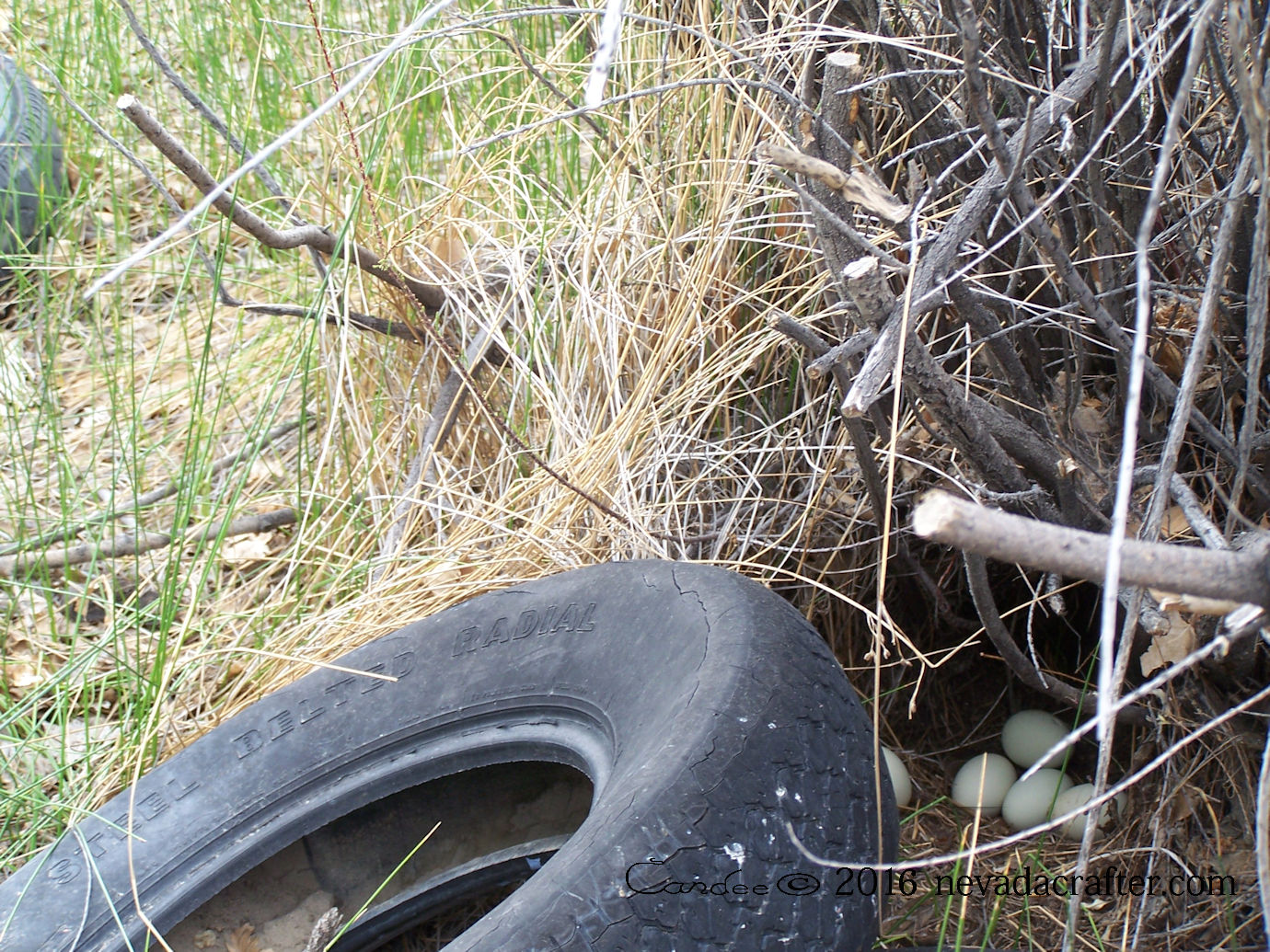
   As a kid growing up here in Fallon, Nevada we always raised our own chickens. Dad would place a fake egg in the nest box so the hens would lay their eggs where he wanted them to. But this did not always work, especially with chickens that were being raised free range. One of my daily chores was to find all the rogue chicken nests and collect the eggs. Needless to say, by the time Easter rolled around I was sick of hunting for chicken eggs.
    As you can see here in the photo things haven't changed much. This is a rogue nest belonging to an Ameraucana chicken and what makes it worse is that they lay colored eggs. Now this breed is not the most egg productive but I have found them to be very resilient to cold weather and when being raised free range they are quite happy to take care of themselves for the most part, with the exception of an occasional feeding to remind them where home is. Rather than trying to force the hen to lay her eggs where I want them, I simply mark the nest, leave a dummy egg in the nest and continue to collect eggs.

Tuesday, April 5, 2016

What's a chicken brooder ?

A chicken brooder is what you raise baby chicks in.

A brooder is well worth the investment if you're going to be raising baby chicks on a regular basis. But if you don't have the money they can easily be made. All you need is a large plastic storage container, a couple of lightbulbs some duct tape and stick to go crossed the top. You don't need the lid just the tub itself. The tub should be at least 16" deep so chicks can't jump out. Line the bottom with newspaper, wood shavings or clean sand and suspend the double light over the tub using the stick and duct tape. [NOTE: do not use newspaper or any other slick surface with turkeys or larger poultry, as the slick surface may cause straddle leg and may cripple your poultry.  Also make sure that whatever material you use for bedding, that it is a material that can be periodically cleaned out. And never use colored newspaper as it may contain lead in the ink.]  Make sure that the lightbulb is close enough to the bottom that the chicks can put their body next to the light (40 to 60 W bulbs) but not touching or close enough to be a fire hazard. You should be able to place your hand underneath the lightbulb and comfortably leave it there. If it is too hot simply raise the lightbulbs an inch or so.  The reason I use two lightbulbs is in case one of the lightbulbs burns out. It is important that the chicks can move away from the light if they need to, as they will regulate their own body temperature by moving next to the light and then away from it. Most feed stores use a large water trough with heat lamps suspended over the top at one end. If you have more than 10 chicks at a time, a heat lamp may work better because it will cover a larger area. You should locate your brooder in a place that is free from drafts, away from children and predators such as cats. [NOTE: children should not handle baby chicks as their droppings can contain salmonella and other diseases that children can pick up if they put their hands in the mouth after handling the baby chicks. Always wash your hands after handling baby chicks so you do not transmit diseases to other animals or yourself.]
Old Sears and Roebuck refurbished chicken brooder

    Now normally I'd be using the brooder heater in the back but as I only have three or four chicks the double lightbulb will work out better. The heater is an old heater and doesn't always heat as well as I think it should and even though it is adjustable for this small a number of chicks, the lights will work better. I've added newspaper to the bottom temporarily for a couple of days so the chicks can get acclimated and to give a little added warmth. Even though chickens are not susceptible to straddle leg, I will remove the newspaper in three or four days. One of the things that I think is important to do is to introduce your baby chicks to the food and water. I do this by dipping each chicks beak in the water dish once so they know where the water is. And then I will tap my finger in the feed dish to simulate a mother hen trying to coax her chicks into eating. For the next few days I will periodically monitor the baby chicks to make sure that each and every chick is drinking and eating normally. I will also look for baby chicks that may not be acting normal or any other indicators of illness. I will also watch for fecal matter(poo) building up on their behind's, which can cause poultry to become impacted. If you should see a large build up of fecal matter, use a moist warm washcloth to gently remove the dried fecal matter. Try not to get the chicks feathers wet, as this can cause the bird to become chilled and go into shock.

    As always if you have additional questions you should go to your local extension office. These offices are located throughout the country and are affiliated with your local agricultural University. So if you have any gardening, farming or agricultural questions these offices can be of great value when you're trying to find answers to problems. You can also obtain pamphlets and brochures on a wide range of how to topics. Including canning and food preservation, recycling, and many more topics than I can mention.
    I hope that this post a is bit of help, if you have any questions please feel free to post them in the comment section. I will do my best to respond in a timely fashion. Thank you for checking out this blog and be sure to check out all our other blogs, YouTube videos and websites on other topics.

http://nevadagarden44.blogspot.com/
www.nevadacrafter.com
http://craft44.blogspot.com/