Showing posts with label livestock. Show all posts

Friday, March 16, 2018

Never raise a chicken by itself, bad things will happen

 
  You know how sometimes an idea sounds good in the beginning, but then goes horribly wrong, kinda like a Frankenstein movie?
            These Americana chickens were free ranging out back when they were attacked by a neighbors dog, leaving one hen and a clutch of eggs. The hen was so traumatized that she did not return to the nest. I did not want to lose this breed of chicken, so I thought I would try to hatch out the eggs in the incubator. Unfortunately out of the 20 or so eggs only one chick hatched out.  
            Now I have always been told by my family, that a chick by itself will not survive. As my family has over a hundred years’ experience raising chickens commercially and non-commercially, I should have taken their advice. My wife seeing the chick, gave it a stay of execution. She heard were they used a feather duster as a surrogate mother, and so we gave it a try. Now while this seemed like a good idea at first, it would later prove to be a mistake.
Cookidoo with feather duster mother
             Yes, the chick was happy with it’s feather duster mother, but as we tried to introduce him to the adult chickens we began to see problems. Physically he was a chicken, but psychologically he had no clue as to what he was or how to act like a chicken.
           It began with him hiding in the feather duster when other chickens came around. I understand that if you had not seen another chicken before you might be a little frightened seeing another full grown chicken. Still, over time you would get over the initial shock I would think, but this did not happen.
Cookidoo as adult rooster
           As the chick grew older and finally able to hold his own, I decided to try putting him in with the other chickens. I locked him in the hen house with the other chickens for several days so that he would know where to roost at night. He seemed to get along okay with the other chickens, but was still staying to himself. When I finally let the chickens back out into the run I was surprised to see him roosting outside of the hen house and not with the other chickens. He was an odd duck, and the other chickens knew it. He wasn't a bad looking rooster, but he just did not act right.
        One day I was out in the chicken run feeding the chickens, and I hear around the corner what sounded like someone crushing an aluminum can. I looked around the corner and all I could see was Cookidoo just standing there as if nothing were wrong. I did note that a couple of aluminum cans had blown into the chicken run, but I did not make the connection between the aluminum cans and Cookidoo . I finally came out one day and heard an aluminum can being crushed, and immediately looked around only to see my crazy rooster trying to mate with a beer can. I was utterly amazed as I watched this unnatural event unfold. As I reached for my phone to videotape what was going on he stopped and gave me a dirty look, as if I had interrupted something very important. Although try as I might to videotape him sexually abusing aluminum cans, he always seemed to be aware of what I was trying to do and would immediately stop. 
Cookidoo  flapping wings
         I thought maybe he eat some peyote or something, but there was no real vegetation growing in the chicken run and the feed was clean. This went on for a couple of days before he realized that the hens were a lot more interesting than an empty aluminum can.  After that all the hens were runing for their lives and the Barred Rock rooster was out of breath chasing Cookidoo all over the yard in an attempt to keep him away from the hens. The hens stopped laying eggs for a week because he was always trying to get on top of the hens as they were trying to lay eggs. I was now finding broken eggs because the nest box only has room for one hen, not a hen and a rooster. I tried to put him outside the run, but he always found a way back in. To this day he still does strange things but he has slowed down and the hens are not as nervous as they used to be.


        So the next time someone tells you that you can raise a chick by itself, think about this, "Just because you can do something, does not mean you should do something."

Tuesday, September 20, 2016

Ravens, friend or foe?

Ravens, extremely smart adversary?

    Most people associate this bird with dead animals and egg stealing. The truth of the matter is, he is an opportunist that is just extremely smart for a bird and knows how to take advantage of his surroundings. University studies have found that he is able to identify people's faces, which means if you wrong a raven he will remember it and harass you as long as he lives. Not only that, he has the ability to teach his offspring that this person is not to be trusted. This species has been known to steal coins out of vending machines, use tools to gather food and to elicit other species of animals to help them find food. 
    Instead of considering the Raven to be an adversary, you may just want to consider him to be an ally. As I mentioned before ravens will elicit other species of animals to help them gather food. This symbiotic relationship with predators such as coyotes, hawks and eagles can be turned to your advantage. The ravens will follow these predators in hopes of stealing food from the predators. So if you hear a raven, you may well expect a predator to also be nearby. Many a time I did not see the coyote or other predator until it was too late, but I always heard or saw the ravens before such an event.
Since then I have many times thanked the raven for letting me know there were predators nearby, thus giving me the opportunity to protect my poultry, or any other livestock prone to such predators. You may not see the predators, but I assure you the raven does. 

Monday, August 29, 2016

Do you need to cut the high cost of electrical fencing to deter predators?

Predators can be the biggest pain in raising poultry and electrical fencing can sometimes be your best deterrent. But like many products on the market today it can get very expensive. There are alternatives to the high-priced electric fencing components. One such alternative is a DIY insulator for stringing your electric wire on. 
So first find a empty plastic soda or water bottle with a fairly deep lid. Don't remove the lid from the bottle until you're done making your holes and a slit. I use the water bottle to hold the lid so I can safely drill and cut the lid without having to have my hands in close proximity to cutting blades. First I drill an 8th inch hole all the way through the lid so that it comes out the other side.
 I then take a saw such as a Dremel saw blade and I cut a slit from one whole to the other.
Then I drill a 16th inch hole in the top of the lid. 
This is what I will use to screw the insulator to a fence post. Preferably a screw that will set recessed away from the wire. Optionally, once I have attached the insulator to the fence post I may use a small dab of silicone or hot glue to insulate the wire from screw if I think the wire is too close to screw. 
(A small piece of plastic placed in the lid, over the screw will also work.)
 Once I have attached the DIY plastic insulator I will give it a good coating of spray paint to keep the plastic from decomposing. Almost all plastics are treated with cornstarch so they will decompose. Personally I think it's just so that they can force people to buy more product but nonetheless a coating of spray paint will prevent plastics from decomposing. 
 
At this point you're ready to string your electric fencing, just slide the wire down through the slot into the holes on either side as shown in the photograph above.
Attach your electrical fencing to the charger and you're ready to go.


Be sure and check out our other blogs


Tuesday, August 9, 2016

Chicken predators, the loss of my Americana chickens

The loss of my Americana chickens.

    The loss of a chicken flock is never easy to take. You always feel as if you didn't do enough to protect your flock. Living in the deserts of Nevada you are always thinking about predators. Every fence, every cage and every chicken hutch is built with predators in mind. And it really doesn't matter what type of livestock or garden crop you're raising, the wildlife here in the desert considers anything and everything that you are growing as part of the menu. It is only a matter of time before a predator takes notice and then the battle of wits begins. 
    Coyotes are far more intelligent than dogs but both species consider a fence a minor obstacle. But unlike dogs, coyotes will actually sit, watch and then analyze in order to find a solution to a problem or in this case my fence and a chicken coop. Once they find a solution they not only act upon it themselves but convey the solution to other members of the pack and work as a team in a coordinated effort to get at their prey.  
    I actually watched a coyote pack run a jackrabbit to ground. The coyote pack sat on a hill as each member took turns chasing the jackrabbit. Normally the jackrabbit can out run a single coyote, but the coyote knows that a jackrabbit is territorial and won't run outside of its own territory . This means the jackrabbit will continually run in a circle until it can't run anymore. 
    Now in my case the fence was not a real problem as I had not completed it yet. The problem was I locked up my chickens at night and only allowed them to free range during the day. Solution; attack the chicken flock during the day when the owner was away. Which means the coyotes had been watching for several days before they made an actual move on the flock. 
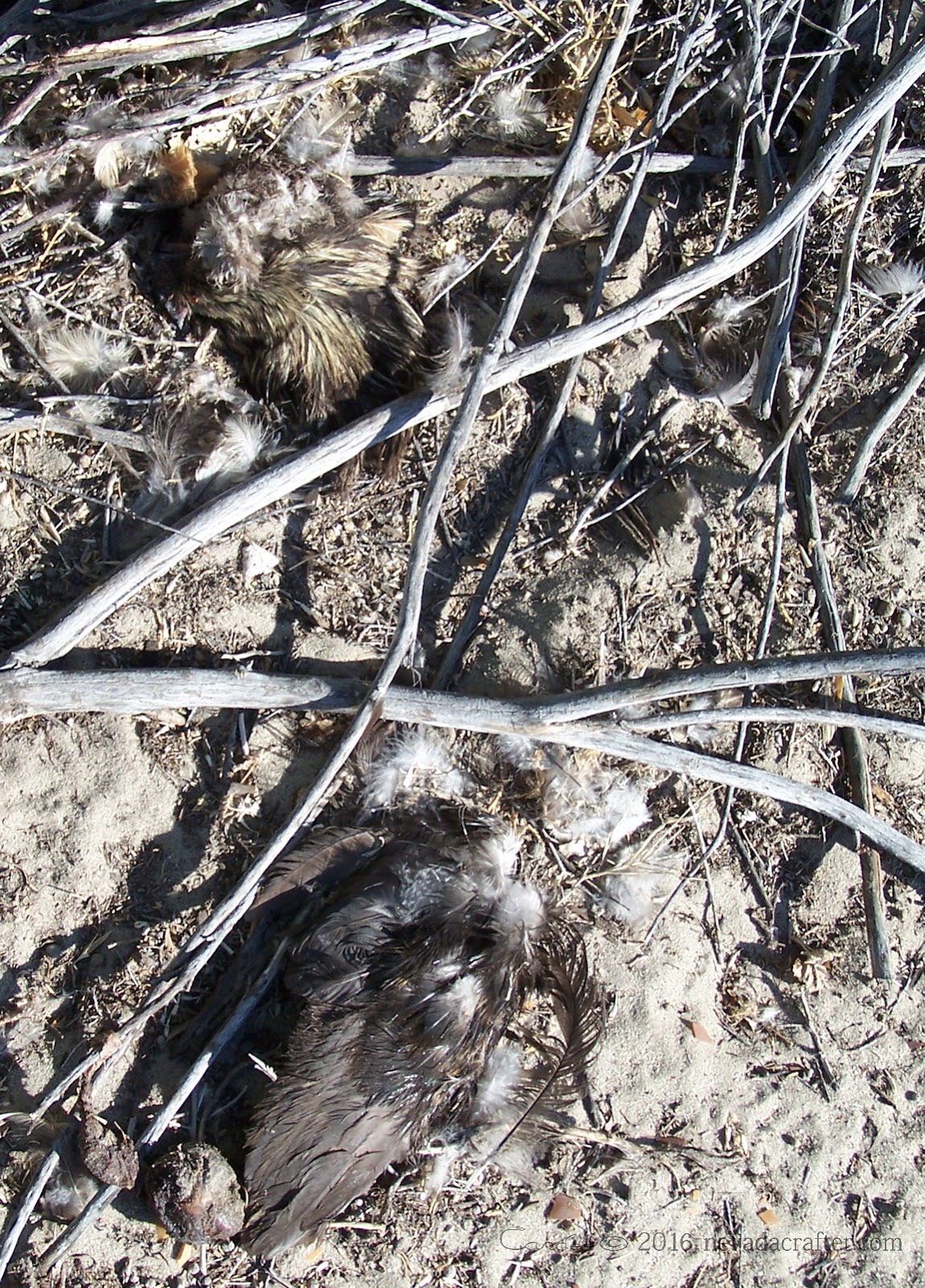
Remains of Americana chickens after coyote attack.
    The photo above is what remains of my Americana chickens. You have to give coyotes credit, they seldom leave any waste behind. The only thing that I was able to find was a head and a couple of wings. This may be a gruesome sight to some, but growing up in the deserts of Nevada and being around wildlife and livestock all the time gives you a different perspective on life. This sort of event takes place daily as animals in the desert struggle to survive. For that matter everything in this universe feeds on everything else, and every living thing must consume some other living thing in order to survive. 
    Now the mistakes I made were several. The first mistake I made was in letting my guard down because I had not had a coyote attack in several years. I assumed that the chickens would be safe as long as I locked them up at night. 
    The second mistake I made was not completing the fence before letting the chickens to free range . Usually I run one or two strands of Barb wire at the bottom of the fence and below ground. This is usually enough to deter most predators but as I have found with coyotes they are problem solvers and the minute you solve one problem they will find another chink in your armor when you're not looking. 
    The third mistake that I made was not paying attention to the other wildlife in the area . I had noted several ravens hanging around before the attack took place . Ravens are a scavenger bird and probably even more clever than the coyotes. But the one thing I've learned about ravens is they like to follow predators so they can pick up on the left overs . I had not seen any hawks and mistakenly assumed the ravens were just simply passing through. 
    The fourth mistake was not remembering my own history . The last time they attacked they wiped out a flock of 20 barred rock chickens in a single night and I never did find even a single body part. 
    As to the hole under the fence and I am not sure if it was a way out or a away in, but unfortunately I've had to set steel traps in hopes of catching the predators responsible.  This also poses the dilemma of trying to keep my own dog out of the traps and having to lock up my other flocks of chickens even in the heat of the day. 
    I now have an unexpected project of trying to improve my defenses and anticipate another attack. The coyotes have learned that there is an easy meal here and most likely will not leave until all my chickens are gone. 
    And so life goes on as I continue my own struggle to survive under trying times and difficult conditions. The desert is relentless and if it is not coyotes it is something else. The challenge is to learn from my mistakes and at the same time realize that nothing is forever. That when I am no longer here, the desert will undo everything I have done and reclaim what I have taken from it. 

Tuesday, April 5, 2016

What's a chicken brooder ?

A chicken brooder is what you raise baby chicks in.

A brooder is well worth the investment if you're going to be raising baby chicks on a regular basis. But if you don't have the money they can easily be made. All you need is a large plastic storage container, a couple of lightbulbs some duct tape and stick to go crossed the top. You don't need the lid just the tub itself. The tub should be at least 16" deep so chicks can't jump out. Line the bottom with newspaper, wood shavings or clean sand and suspend the double light over the tub using the stick and duct tape. [NOTE: do not use newspaper or any other slick surface with turkeys or larger poultry, as the slick surface may cause straddle leg and may cripple your poultry.  Also make sure that whatever material you use for bedding, that it is a material that can be periodically cleaned out. And never use colored newspaper as it may contain lead in the ink.]  Make sure that the lightbulb is close enough to the bottom that the chicks can put their body next to the light (40 to 60 W bulbs) but not touching or close enough to be a fire hazard. You should be able to place your hand underneath the lightbulb and comfortably leave it there. If it is too hot simply raise the lightbulbs an inch or so.  The reason I use two lightbulbs is in case one of the lightbulbs burns out. It is important that the chicks can move away from the light if they need to, as they will regulate their own body temperature by moving next to the light and then away from it. Most feed stores use a large water trough with heat lamps suspended over the top at one end. If you have more than 10 chicks at a time, a heat lamp may work better because it will cover a larger area. You should locate your brooder in a place that is free from drafts, away from children and predators such as cats. [NOTE: children should not handle baby chicks as their droppings can contain salmonella and other diseases that children can pick up if they put their hands in the mouth after handling the baby chicks. Always wash your hands after handling baby chicks so you do not transmit diseases to other animals or yourself.]
Old Sears and Roebuck refurbished chicken brooder

    Now normally I'd be using the brooder heater in the back but as I only have three or four chicks the double lightbulb will work out better. The heater is an old heater and doesn't always heat as well as I think it should and even though it is adjustable for this small a number of chicks, the lights will work better. I've added newspaper to the bottom temporarily for a couple of days so the chicks can get acclimated and to give a little added warmth. Even though chickens are not susceptible to straddle leg, I will remove the newspaper in three or four days. One of the things that I think is important to do is to introduce your baby chicks to the food and water. I do this by dipping each chicks beak in the water dish once so they know where the water is. And then I will tap my finger in the feed dish to simulate a mother hen trying to coax her chicks into eating. For the next few days I will periodically monitor the baby chicks to make sure that each and every chick is drinking and eating normally. I will also look for baby chicks that may not be acting normal or any other indicators of illness. I will also watch for fecal matter(poo) building up on their behind's, which can cause poultry to become impacted. If you should see a large build up of fecal matter, use a moist warm washcloth to gently remove the dried fecal matter. Try not to get the chicks feathers wet, as this can cause the bird to become chilled and go into shock.

    As always if you have additional questions you should go to your local extension office. These offices are located throughout the country and are affiliated with your local agricultural University. So if you have any gardening, farming or agricultural questions these offices can be of great value when you're trying to find answers to problems. You can also obtain pamphlets and brochures on a wide range of how to topics. Including canning and food preservation, recycling, and many more topics than I can mention.
    I hope that this post a is bit of help, if you have any questions please feel free to post them in the comment section. I will do my best to respond in a timely fashion. Thank you for checking out this blog and be sure to check out all our other blogs, YouTube videos and websites on other topics.

http://nevadagarden44.blogspot.com/
www.nevadacrafter.com
http://craft44.blogspot.com/

Sunday, August 17, 2014

Do you need a rooster to raise chickens?

Do you need a rooster to raise chickens?


 Although a rooster is not a necessity for chickens to lay eggs, the rooster does provide some protection for the hens especially if they are free range. I have raised chickens with and without roosters and I do find they are less prone to hawks and some other predators. Basically, the hens are less nervous and more relaxed if they know a rooster is looking out for them. The rooster will watch over his hens and warn them when danger is nearby and in some cases will try to physically protect his hens if the threat is not too overwhelming. It really depends on the personality of the rooster. I have seen some roosters cut and run with the rest of the hens, while others will stand their ground no matter what the foe may be. This is especially true of Bantam roosters who seem to have more fight in them than most. It should also be noted that Bantam hens make better mothers and if you want to hatch an egg put it under a Bantam hen.
    The rooster will also help them find food but sometimes this is more a ploy than an actual benefit to the hens. As the rooster will use a food call to get close enough to the hens in order to mate with them. This said the rooster remembers places where there is plentiful food and will lead a flock time and again to such a place in order to take advantage of it.
    If you raise your hens without a rooster invariably one of the hens will assume the role of rooster. This is nature's way of filling a gap and is part of the pecking order but I find that a real rooster does a better job than a hen pretending to be one. A hen pretending to be a rooster will also be more concerned with deciding who is boss and who gets the most food than protecting the flock. A rooster that finds food will make sure that all the hens know there is food nearby, whereas a hen pretending to be a rooster will simply try to keep the food to herself.

Tuesday, November 19, 2013

A better chicken coop and chicken runs

A better chicken coop and chicken runs

The basic idea is to give the chickens fresh green feed without actually letting them run loose. Living here in the desert there is a long list of predators, including some that people might not expect. This is not to say that you cannot free range your chickens, it just means if you do you should expect to lose a few chickens from time to time. coyotes, dogs, cats, skunks, raccoon, weasels, hawks and eagles are just a few of the many predators I deal with on a regular basis. As a result poultry runs need to have netting on top to keep hawks and eagles from thinking your chickens are a buffet.