Showing posts with label raising chickens. Show all posts

Tuesday, March 7, 2017

Caged or free range which is better?

    Caged or free range which is the safer food source? 

     Animal rights activists and the food industry, would have you believe that the free range animal is happier and therefore healthier, but is that true?

    Free range poultry feed on various vegetation and are extremely fond of insects and small rodents. Turkeys, in particular have no qualms about eating small mice and anything else that is crawling on the ground. 
    As a result like most livestock (this includes goats, sheep, cattle, etc.) that is free range, poultry is exposed to various parasites because they are feeding on things that are on the ground. Poultry can have many different parasites living within them including tapeworms, eye worms, roundworms, cecal worms ect. Fortunately for the poultry (chickens, etc.) for the most part do not have a problem with these parasites unless the parasite infestation becomes excessive, which is rare. 
    In addition range free animals are exposed to wild animals which can carry more than just parasites, but also various diseases. 
    
Grasshopper represents one of thousands of different poultry food sources.
    Caged or cage free poultry is raised within a confined environment where their food and living environment are kept as sterile and disease free as possible. Their food is controlled and measured and in some cases treated with antibiotics and steroids. These factory farms have a great deal invested in these animals and as a result go to great lengths to keep their livestock healthy. The idea that these large farms are not interested in healthy animals is ludicrous. Unhealthy animals do not produce and jeopardize the entire operation. 
   Now don't get me wrong, I'm all in favor of range free, grass fed animals. I do not believe people should be eating any animal that has been treated with steroids, antibiotics or God knows what. I believe that if an animal food product is handled and processed properly, using food safety standards, it can be just as safe if not safer than any other food product. 

    So we come to the question at hand, which is better caged or range free?

  1. Is range free just another marketing ploy to get you pay more for a product that is not any safer to consume than a caged animal?
  2. If you raise a chicken inside a sterile bubble and feed it only sterile food will it produce a safer food product or will it produce a meat product that is devoid of anything nutritional?
  3. If the label says range free, grass fed, non-GMO, etc. how do you know you're getting what you're paying for?
  4. A recent survey of fish markets found as much as 85% of all fish in your local market is mislabeled and not what it says it is. So how do you know you're getting ground turkey as opposed to ground chicken or is it a mix of something else?
  5. In the old days poultry producers were required to leave the head on any butchered animal. This was to prevent farmers from selling a duck as a chicken etc. It was also done so that you could tell how fresh the meat was. Do we need to return to such methods?

    And as always keep asking questions


Tuesday, August 9, 2016

Chicken predators, the loss of my Americana chickens

The loss of my Americana chickens.

    The loss of a chicken flock is never easy to take. You always feel as if you didn't do enough to protect your flock. Living in the deserts of Nevada you are always thinking about predators. Every fence, every cage and every chicken hutch is built with predators in mind. And it really doesn't matter what type of livestock or garden crop you're raising, the wildlife here in the desert considers anything and everything that you are growing as part of the menu. It is only a matter of time before a predator takes notice and then the battle of wits begins. 
    Coyotes are far more intelligent than dogs but both species consider a fence a minor obstacle. But unlike dogs, coyotes will actually sit, watch and then analyze in order to find a solution to a problem or in this case my fence and a chicken coop. Once they find a solution they not only act upon it themselves but convey the solution to other members of the pack and work as a team in a coordinated effort to get at their prey.  
    I actually watched a coyote pack run a jackrabbit to ground. The coyote pack sat on a hill as each member took turns chasing the jackrabbit. Normally the jackrabbit can out run a single coyote, but the coyote knows that a jackrabbit is territorial and won't run outside of its own territory . This means the jackrabbit will continually run in a circle until it can't run anymore. 
    Now in my case the fence was not a real problem as I had not completed it yet. The problem was I locked up my chickens at night and only allowed them to free range during the day. Solution; attack the chicken flock during the day when the owner was away. Which means the coyotes had been watching for several days before they made an actual move on the flock. 
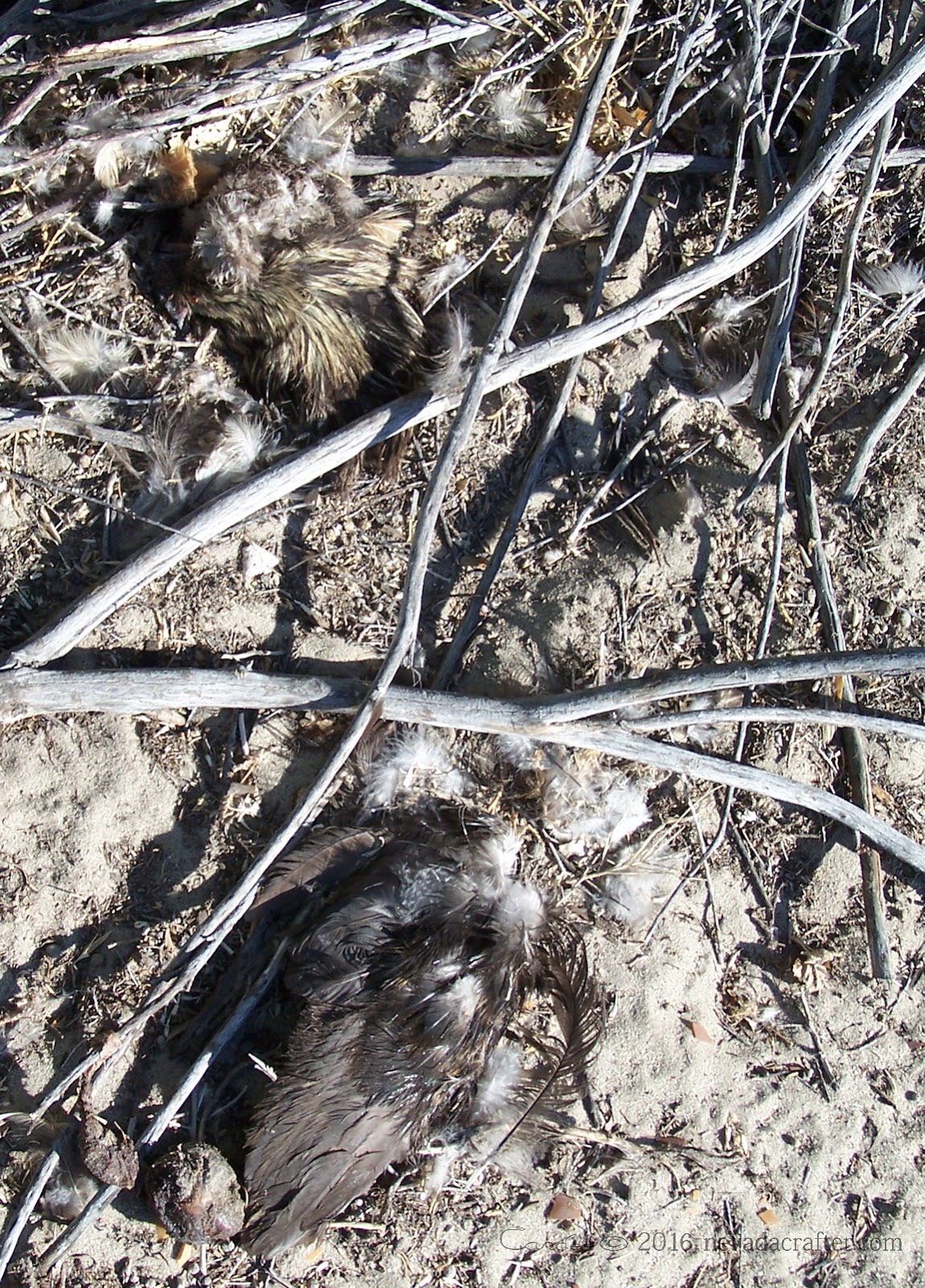
Remains of Americana chickens after coyote attack.
    The photo above is what remains of my Americana chickens. You have to give coyotes credit, they seldom leave any waste behind. The only thing that I was able to find was a head and a couple of wings. This may be a gruesome sight to some, but growing up in the deserts of Nevada and being around wildlife and livestock all the time gives you a different perspective on life. This sort of event takes place daily as animals in the desert struggle to survive. For that matter everything in this universe feeds on everything else, and every living thing must consume some other living thing in order to survive. 
    Now the mistakes I made were several. The first mistake I made was in letting my guard down because I had not had a coyote attack in several years. I assumed that the chickens would be safe as long as I locked them up at night. 
    The second mistake I made was not completing the fence before letting the chickens to free range . Usually I run one or two strands of Barb wire at the bottom of the fence and below ground. This is usually enough to deter most predators but as I have found with coyotes they are problem solvers and the minute you solve one problem they will find another chink in your armor when you're not looking. 
    The third mistake that I made was not paying attention to the other wildlife in the area . I had noted several ravens hanging around before the attack took place . Ravens are a scavenger bird and probably even more clever than the coyotes. But the one thing I've learned about ravens is they like to follow predators so they can pick up on the left overs . I had not seen any hawks and mistakenly assumed the ravens were just simply passing through. 
    The fourth mistake was not remembering my own history . The last time they attacked they wiped out a flock of 20 barred rock chickens in a single night and I never did find even a single body part. 
    As to the hole under the fence and I am not sure if it was a way out or a away in, but unfortunately I've had to set steel traps in hopes of catching the predators responsible.  This also poses the dilemma of trying to keep my own dog out of the traps and having to lock up my other flocks of chickens even in the heat of the day. 
    I now have an unexpected project of trying to improve my defenses and anticipate another attack. The coyotes have learned that there is an easy meal here and most likely will not leave until all my chickens are gone. 
    And so life goes on as I continue my own struggle to survive under trying times and difficult conditions. The desert is relentless and if it is not coyotes it is something else. The challenge is to learn from my mistakes and at the same time realize that nothing is forever. That when I am no longer here, the desert will undo everything I have done and reclaim what I have taken from it. 

Monday, April 4, 2016

My first successful incubator hatch

Hatching chickens in a incubator. 


    This is my first successful attempt at hatching chicken eggs in a incubator. In the above photo you can see the chicks starting to peck their way out of their eggs at day 20. (chickens take 21 days to hatch.)
    In my first attempt, I mistakenly tried to hatch turkey eggs, which I later learned that the broad breasted and hybrid turkeys require artificial insemination in order for the eggs to be fertile. The tom turkeys are simply too heavy to perform their required duties. In the end, I realized I should have tried to hatch chicken eggs first, just to get a little experience. 
    Prior to this, I was allowing hens to set on their eggs and hatch them out. The advantage to this is I do not have to keep a constant eye on a incubator's temperature and humidity. I don't have to worry about power outages or other problems. And afterward, the hens do a fair job of looking after the baby chicks by keeping them warm and feed. 
    The disadvantage is that some hens are inexperienced and would only hatch out one or two eggs out of a clutch of 12. In addition, by allowing the hens to do the work it also takes that particular hen out of production for several months. This means that if she was laying an egg a day, I might be out 200 eggs during that time. 
    My father told me that they use to keep a few Bantam chickens on the homestead for the sole purpose of hatching out eggs. The bantams eggs were too small to have much commercial value, but they made the best mothers and would hatch out just about anything, including goose eggs. In addition to that, the bantams being so small, were pretty much self-sufficient, and if allowed to free range would fend for themselves.
   Here to the right you see the wet, less than a day old chicks. It takes about a day for the chicks to dry out in the incubator before I can move them to the brooder. Baby chicks can survive for several days on their internal food stores. This is why baby chicks can be shipped across country with little ill effect. 
    In this first successful attempt, I was actually surprised that I got any of them to hatch. I had three power outages and on several occasions the temperature or humidity drop below what was recommended. 
    I also had to collect eggs for 10 to 12 days before I had enough eggs to put in the incubator. I put the eggs in an egg carton and in a room that stayed around 55 to 65° and turned them twice a day by hand. Too cold the eggs would've died, and too warm the eggs would've began to incubate.
    The best advice that I can give you is make sure you read all the instructions that comes with your incubator. Then go to your local extension office for any of your farming or homesteading information. They are a great resource for many topics and directly connected with your local agricultural university. And of course don't forget to look for additional information on the Internet.

Wednesday, April 22, 2015

April poultry Feed Prices for Fallon, Nevada

April 2015 Poultry Feed Prices Fallon , Nevada

Kents Supply 
260 N. Maine St. 
Fallon, NV 89406

Hen Scratch 50# bag ..............................................$12.29 [24.5 cents per pound}

Lay Pellets 50# bag 16% protein ...........................$14.99 [30 cents per pound]

Big R store
3325 Reno Hwy
Fallon, NV 89406

Hen scratch 40 pounds............................................ $10.99 [27.4 cents per pound]
lay pellets 16% protein 50 pounds  ......................... $16.99 [34 cents per pound]
lay crumbles 16% protein 50 pounds .......................$16.99  [34 cents per pound]

Wal Mart
2333 Reno Hwy
Fallon, NV 89406

Chicken (hen) scratch 40 pounds .............................$8.98 [22.5 cents per pound]
egg maker crumbles 15% protein 40 pounds........... $11.98 [30 cents per pound]
(egg maker crumbles are comparable to lay crumbles)

    The above prices are as of April 22, 2015.

As I have noted over the years feed prices have stayed consistent with all retailers. It should be noted that Big R and Walmart both sell bags of feed in different weights such as 40 lb. This gives the delusion that the feed or food product is cheaper when in actuality it is not. It is a common practice used on all products sold in the US and should be especially watched for when the packaging says new or improved. 
    (Note) hen scratch is a combination of several grains such as corn wheat and barley. The percentage of corn or other grain can be changed in order to adjust profit margins and the prices reported here does not reflect what percent of which grain is used most. It should also be noted that in some products you may find more chaff than in others. It should also be noted that it may be cheaper to create your own hen scratch by buying the separate grains and mixing your own hen scratch.
    My father told me that when they were raising large flocks of 1000 birds or more on the homestead they would actually buy grain by the railcar load. Essentially buying direct from farmers cutting the middleman completely out. When they had to buy smaller quantities they would collaborate with other farmers to split the feed and the cost. 

[It should be noted that the above list is composed of the feeds that I use most often and stores that I frequently visit. It is not representative of all the feeds available by these retailers or their prices. I also do not guarantee prices quoted above and prices and other information are subject to change. The list is for subjective reference purposes only and to get accurate prices and a list of available feeds you should contact or visit your feed store directly]